Sunday, February 23, 2014

Lieutenant Ecaterina Teodoroiu and the Romanian army


Ecaterina Teodoroiu
Courtesy of the National Military Museum, Bucharest, Romania
 
During the spring of 1917, the Romanian military leadership took serious steps to reorganize and retrain its remaining forces. Ecaterina took advantage of all the training available to her, eager to prove herself worthy of her new rank. Now the commander of a troop, she was given the authority to instruct other soldiers, often substituting for her own commander when he wasn’t available to teach.

            The Romanian army emerged from its period of reorganization ready to fight more effectively. Their subsequent victory during the Battle of Mărăşti greatly surprised the Germans and Austrians and gave the Romanian army a new sense of confidence as they prepared for another battle, one that would be fought at Mărăşeşti. As the units in Ecaterina's division -- kept in reserve until the final days of the battle -- marched towards Mărăşeşti, they were impatient to face the enemy...

Excerpt from "Ecaterina Teodoroiu: Lieutenant Girl" from Women Heroes of World War I.
 

Civilian Ecaterina Teodoroiu helps Romanian defenses


Bridge over the Jiu River, 1916
Courtesy of the National Military Museum, Bucharest, Romania
 
At nine o’clock that morning, the Germans had reached the bridge over the Jiu River that led into Târgu Jiu. There were only 150 Romanian soldiers in the local garrison, not nearly enough to repel the Germans. Reinforcements were promised, but time was running out. The Germans were getting closer.

            Suddenly, civilians from Târgu Jiu appeared: old men, women, and children eager to defend their city, carrying whatever weapons they could find. “To Jiu! To the bridge!” they cried. “We must defend the bridge! We will not let the enemy enter our town!”

            Many who witnessed the fierce civilian defense of the bridge that day were especially impressed with the city’s women and girls, who, despite the obvious danger, fired weapons, transported ammunition, and tended the wounded. One eyewitness noticed in particular a young woman who was guiding some Romanian troops to the bridge. Then she joined the other scouts—her orders and encouragements heard amidst the roar of the guns—who were taking an enthusiastic and active role in the defense of the bridge, firing weapons on the enemy. The young woman's name was Ecaterina Teodoriou.


Excerpt from "Ecaterina Teodoriou: Lieutenant Girl" from Women Heroes of World War I.

Flora Sandes: British woman, Serbian soldier


Flora Sandes
On the snowy night of November 15, 1916, a British woman in a Serbian army uniform found a spot on the slope of a steep, mountainous incline where she could sleep for the night. The Serbians were in the process of pushing the Bulgarians back from this corner of Serbia, which the Bulgarians had seized a year before. But the Bulgarians still had control of two strongholds, one of them at the top of this peak. The woman was waiting below with the rest of her regiment, approximately 500 men. It had totaled 2,000 only three months before...

            She and the rest of the regiment were suddenly awakened at dawn by the sound of rifle fire and the very audible voices of Bulgarians shouting “Hourra! Hourra!” A group of them were driving a different regiment of Serbs down the mountain. Flora and the men with her charged up to attack whoever had been left to guard the top.

            Suddenly, out of the mist, Bulgarians appeared directly in front of Flora and the rest of the regiment. The Bulgarians ducked behind some rocks and threw grenades into the midst of the Serbs. Flora suddenly felt as if a house had fallen on her. She couldn’t see. She couldn’t get up. She was conscious that the rest of the regiment was retreating...
 
Excerpts from "Flora Sandes: 'Remember You're a Soldier' " from Women Heroes of World War I.

American Journalst Bessie Beatty interviews members of the Women's Battalion of Death


Bessie Beatty in Russia (from The Red Heart of Russia).
 
Members of the Women's Battalion of Death
 
 
One American war correspondent, Bessie Beatty, stayed with the women in their barracks for a week while they awaited their orders to the front. She asked some why they had joined the Battalion of Death. Beatty discovered that many of them had joined because they felt that their country’s very existence was at stake and that “nothing but a great human sacrifice could save” it. Some were trying to escape personal issues: “My reasons are so many that I would rather not tell them,” one of them told Beatty. Others had lost their entire families in the war: “What else is left for me?” asked one Cossack girl. Two of the women had been Red Cross nurses and had seen too many Russians die at the hands of the Germans; they felt it would be tragic for Russia to be defeated after so much loss.
 
Excerpt from "Maria Bochkareva and the Women's Battalion of Death" from Women Heroes of World War I.
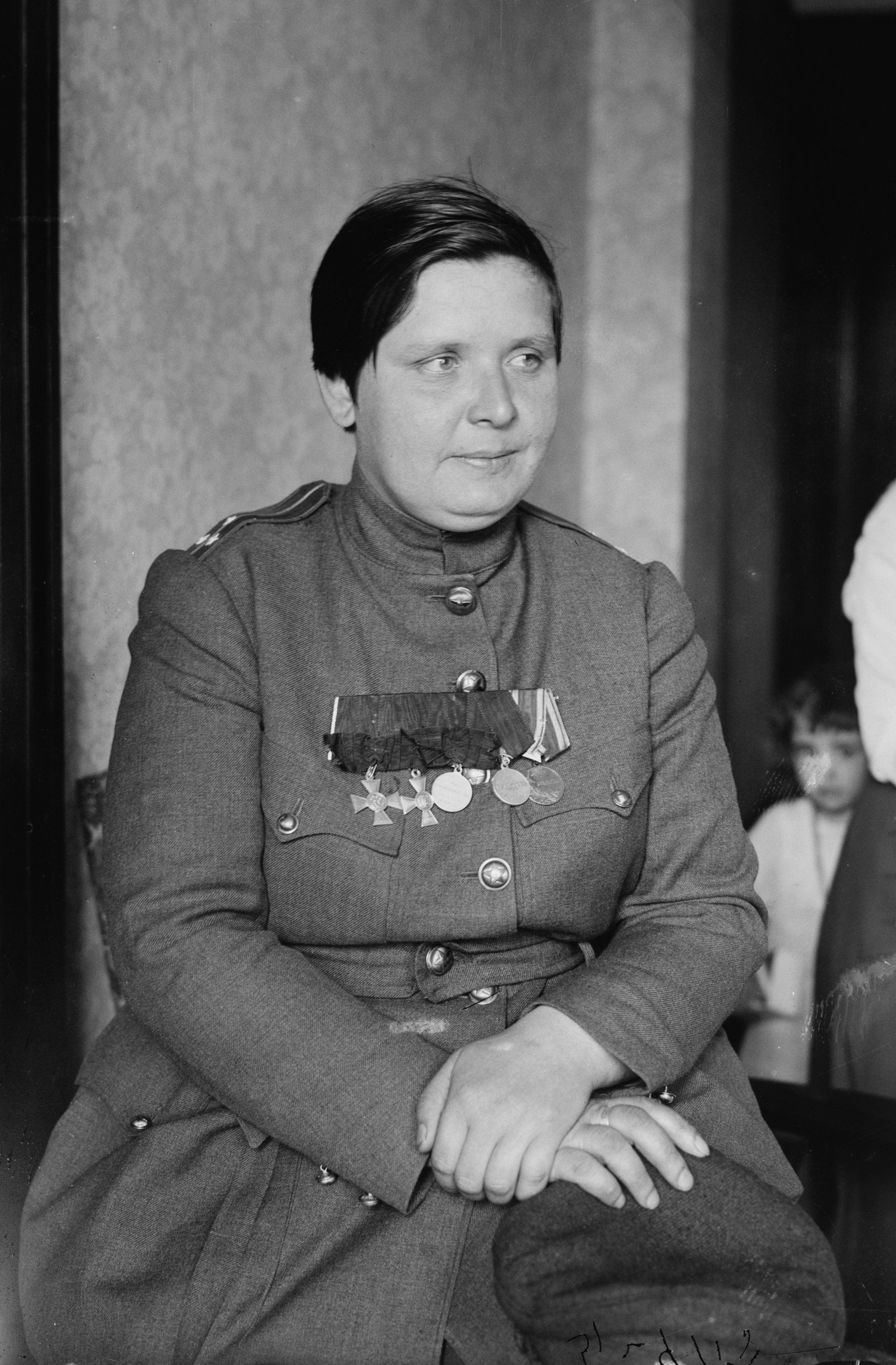
Maria Bochkareva: Recruiting speech for the Women's Battalion of Death


Maria Bochkareva
 
“Men and women citizens! Our mother is perishing. Our mother is Russia. I want to help save her. I want women whose hearts are loyal, whose souls are pure, whose aims are high. With such women setting an example of self-sacrifice you men will realize your duty in this grave hour! Women, do you know what I have called you here for? Do you realize clearly the task lying ahead of you? Do you know what war is? War! Look into your hearts, examine your souls and see if you can stand the great test.”

One of Maria Bochkareva's recruiting speeches, included in "Maria Bochkareva and the Women's Battalion of Death" from Women Heroes of World War I.

Saturday, February 22, 2014

The Women's Battalion of Death charges the enemy lines


Members of the Battalion of Death during a physical drill


"On July 9, the 525th Regiment of the Russian army crouched in the trenches. Looking across 800 feet of no-man’s-land, they could see movement in the German trenches. They were awaiting orders to charge. Their mission? To capture specific territory held by the enemy in the forests of Novospasskii and Begushinskii along with some nearby villages. The regiment had waited through a tense night. At three o’clock in the morning, the order to advance finally came. But no one moved. The officers begged their men to act, but they refused. The debate between the officers and their men dragged on for hours, but nothing was decided. The ideal time for an attack was quickly passing.

Suddenly a large group of women in soldier’s uniform, accompanied by 75 male officers and 300 fighting men, leapt from the Russian trenches and charged toward the German line, all of them running straight into a hail of enemy bullets..."


Opening paragraphs from "Maria Bochkareva and the Women's Battalion of Death" from Women Heroes of World War I.


Friday, February 21, 2014

Shirley Millard: American Nurse in France


American nurses on their way to France
Copyright Steve Hooper
 
...When Shirley and the unit arrived in France, they were told they were to be rushed to an emergency hospital that had been set up quickly close to the French defense line on the grounds of a chateau. “We are all thrilled to have such luck,” Shirley wrote in her diary. “Real war at last.” They arrived just as darkness was beginning to fall. Covering the grounds of the chateau, outside the hospital barracks, were what appeared to be sleeping men. Shirley soon discovered that these were the wounded who had been transported from the battle and left alone on the grounds until someone could help them or, in many instances, discover whether they were alive or dead. Many of these men had already been waiting for hours—often, days—on the battlefield and received only whatever simple treatment could be given to them in rudimentary dressing stations directly behind the trenches. They had to wait there until nightfall when it would be safer to drive to better-equipped hospitals like the one Shirley had been assigned to.

            She never forgot the first moment she entered the hospital barracks and went on duty: “Inside, all was confusion, disorder and excitement. Only dim flickers from candles illumined the chaos. Nurses, doctors, orderlies, beds everywhere; yet not nearly enough to take care of the influx of wounded.

            “Stretcher bearers perspired under their loads until the aisles of every ward were packed. And still the grounds outside were full to overflowing. In the darkness under the trees orderlies stumbled about, giving a hurried drink to parched lips that had cried for water for twenty-four hours."
 
Excerpt from "Shirley Millard: Nurse Armed with Enthusiasm" from Women Heroes of World War I.